
Enterprise architecture
Enterprise architecture tool advisory for complex digital organisations
ECOPE provides enterprise architecture tool advisory to help organisations understand, structure, and govern complex digital environments. We help leadership teams gain control over fragmented IT landscapes by creating a clear, connected, and governable view across business capabilities, applications, data, and technology.
Our approach is practical and use-case-driven. We focus on enabling clarity, control, and long-term sustainability by prioritising your data and use cases first, giving you a clear line of sight from challenge to value—without starting from tools or vendor-driven solutions.
Enterprise architecture tooling in practice
An enterprise architecture tool is not documentation for its own sake. An EA tool helps you connect business strategy with technical execution, turning complexity into clarity across the organisation, and must work within your culture, maturity, and ambition.
When properly implemented, an enterprise architecture tool enables informed decision-making, structured governance, and long-term digital resilience.
At ECOPE, enterprise architecture works across four tightly connected dimensions:
- Business architecture – capabilities, operating models, value streams, and strategic priorities.
- Application architecture – systems landscape, dependencies, lifecycle management, and ownership models.
- Information architecture – data flows, accountability, governance structures, and usage transparency.
- Technology architecture – infrastructure, platforms, integration layers, and technical standards.
The true value of enterprise architecture does not lie in analysing each layer in isolation, but in connecting them to create a coherent, governable, and sustainable digital ecosystem that supports confident decision-making.
Why implementing an enterprise architecture tool is challenging today
Most organisations already have an enterprise architecture—even if it is informal, fragmented, or undocumented. Over time, architectural documentation becomes outdated, critical knowledge is dispersed across teams and systems, and governance shifts from intentional to reactive.
In practice, very few organisations with more than a hundred employees can produce a reliable, up-to-date inventory of the applications they actually use—before even considering shadow IT. Visibility often extends to only a fraction of what is truly in operation.
And identifying applications is only the starting point. The real complexity lies in understanding the dependencies:
- Where applications are hosted
- Who owns the underlying infrastructure
- Which systems they integrate with
- What data they process and how sensitive it is
- Where that data flows next
- How business processes operate end to end—including where information spills into unmanaged tools
- Which libraries, models, and data stores underpin internally developed or externally sourced software
This kind of “spaghetti architecture” exists in far more organisations than leadership teams realise. Complexity accumulates over time. Legacy systems remain deeply embedded. Dependencies multiply silently.
When organisations set ambitious targets such as achieving digital sovereignty, complying with DORA, or carrying out a transformation programme, accurate access to architectural information is critical to success.
Implementing an enterprise architecture tool at this stage requires the right discipline to avoid a far too common mistake: taking a tool-first approach.
It is quite understandable: you have researched online marketing material, attended vendor presentations, probably also had a custom demo, and after signing the contract for your next tool, you hope that the tool will provide what you need out of the box.
Oftentimes, this approach fails. Maybe not immediately, but with a high likelihood, you will find yourself one or two years down the line in a position where the enterprise architecture tool you chose does not contain the necessary data to provide the value you need.
At this stage, you might be tempted to start again, this time with a different tool or vendor, only to find yourself in the same position a few years later.
What ECOPE offers is a faster route to success.
Start with your data: gather it, structure it, enrich it, learn from it, and put yourself in a position where you understand exactly what kind of tool you need and will benefit from from the outset.

Why many enterprise architecture tool initiatives fail
Enterprise architecture tool initiatives rarely fail because the tool you chose lacks features—they fail because of how they are implemented.
In practice, common issues include:
- Starting with tools and frameworks before clearly defining the business questions that architecture is meant to answer.
- Adapting your data and environment to the tool, instead of adapting the tool to your exact needs.
- Working with inconsistent, fragmented, or low-quality data, which undermines trust and limits practical impact.
The result is predictable: high effort, limited strategic value, declining internal confidence, and ultimately, abandoned initiatives. Your enterprise architecture tool becomes perceived as overhead rather than as a strategic capability.

How we develop your projects


· Web application development company ·
Our approach: from use cases to maturity
ECOPE takes a different approach to enterprise architecture tool advisory. We start with the concrete questions your organisation needs to answer—today and in the foreseeable future. These use cases define scope, priorities, and depth.
From there, we consolidate and structure the relevant architectural information, creating a connected and governable tool prototype with a view of your digital landscape.
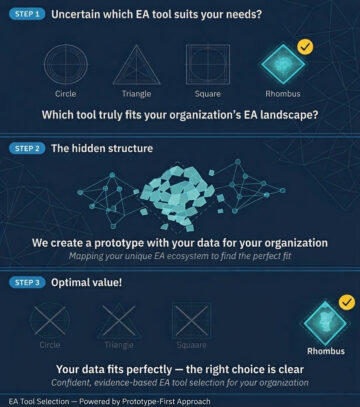
This ensures that:
- Architecture directly supports decision-making.
- Governance foundations are sustainable.
- Tooling discussions happen only when they create measurable value.
Our objective is not to talk about tooling, but to build architectural maturity that evolves with your organisation.
What this enables for your organisation
A well-governed enterprise architecture enables:
- Better strategic and operational decision-making.
- Greater transparency across systems, data, and dependencies.
- Reduced complexity and uncertainty in transformation initiatives.
- Stronger control over technology investments and vendor relationships.
- Long-term resilience in a changing digital environment.
In this way, enterprise architecture becomes a strategic enabler of digital transformation, organisational autonomy, and sustainable growth—independent of short-term technology trends or vendor agendas.
When enterprise architecture tool advisory adds the most value
Enterprise architecture tool advisory delivers particular impact in organisations with:
- Complex or rapidly evolving IT landscapes.
- Multiple platforms, integrations, or external vendors.
- Ongoing transformation, cloud migration, or modernisation initiatives.
- Strategic decisions with long-term technical and operational consequences.
In these environments, architectural clarity is not optional—it is critical.
How we typically engage
Each engagement is tailored to organisational context and maturity, but typically includes:
- An initial architectural assessment and discovery phase.
- Definition and prioritisation of key use cases aligned with business strategy.
- Consolidation of essential architectural views across domains.
- Establishment of governance foundations and accountability models.
Throughout the engagement, ECOPE remains vendor-neutral, advisory-focused, and outcome-driven.
Ready to bring clarity to your enterprise architecture?
If your organisation needs clearer visibility, stronger governance, and solid foundations for long-term digital decision-making, ECOPE provides a practical and structured enterprise architecture tooling approach designed for complex digital organisations.