



Enterprise architecture (EA) is the discipline that connects an organisation’s business strategy with its technology decisions. It maps how capabilities, applications, data, and infrastructure relate to each other — and defines how they should evolve. Without it, technology investments accumulate without direction, dependencies multiply silently, and complexity becomes unmanageable.

TABLE OF CONTENTS
- What is enterprise architecture
- The four domains of enterprise architecture
- Why enterprise architecture matters today
- Why most EA initiatives fail
- A different approach: use-cases before tools
- When enterprise architecture adds the most value
- FAQ
What is enterprise architecture
Enterprise architecture is a structured practice for understanding, designing, and governing how an organisation operates digitally. It is not a document, a tool, or a one-off project. It is an ongoing discipline that helps leadership teams make better technology decisions — with visibility into what they actually have, what it depends on, and what change will cost.
The Federation of Enterprise Architecture Professional Organizations defines it as “a well-defined practice for conducting enterprise analysis, design, planning, and implementation, using a comprehensive approach at all times, for the successful development and execution of strategy.”
In practice: EA gives organisations a shared, reliable view of their digital landscape. That view makes it possible to govern complexity instead of reacting to it.
The four domains of enterprise architecture
A complete enterprise architecture works across four connected layers:
- Business architecture — capabilities, operating models, value streams, and strategic priorities.
- Application architecture — systems landscape, dependencies, lifecycle management, and ownership.
- Information architecture — data flows, governance structures, accountability, and usage transparency.
- Technology architecture — infrastructure, platforms, integration layers, and technical standards.
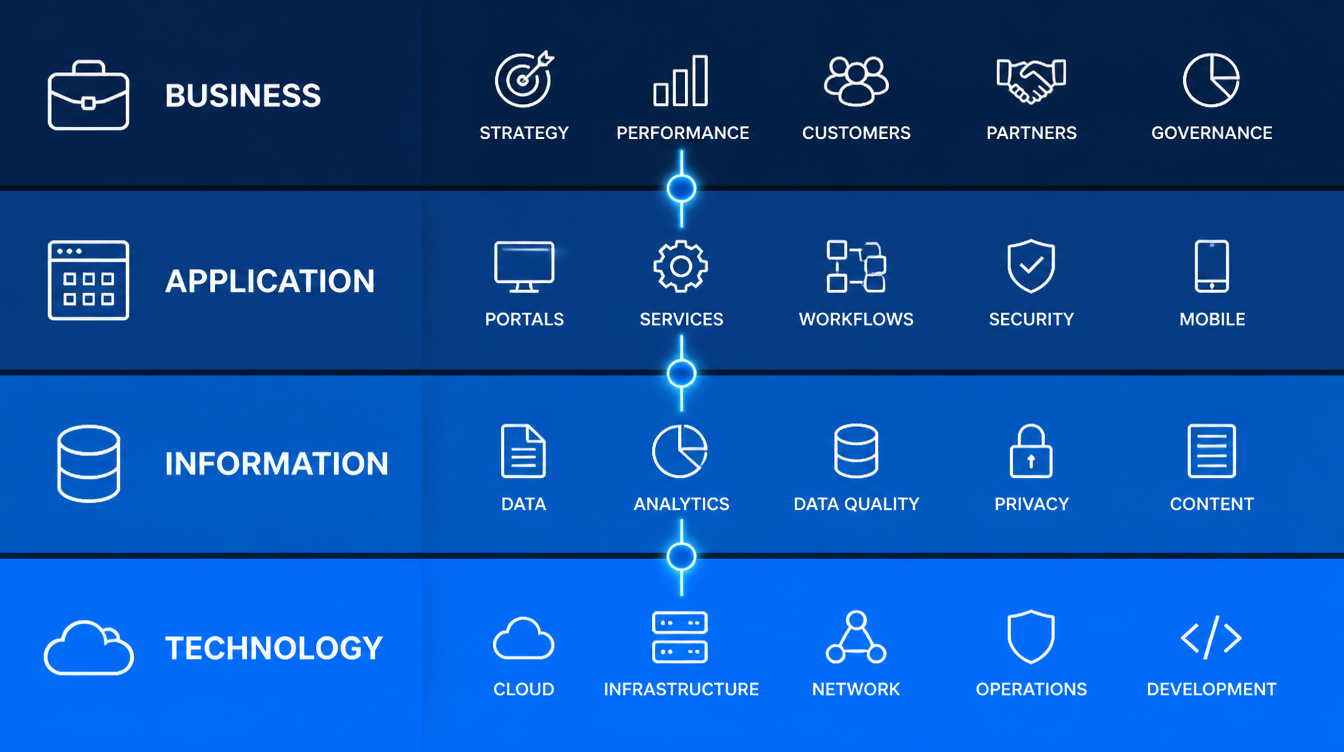
The value is not in analysing each layer in isolation. It is in understanding how they connect — and what breaks when one of them changes.
Why enterprise architecture matters today
Most organisations with more than a hundred employees cannot produce a reliable, up-to-date inventory of the applications they actually use. Visibility often extends to only a fraction of what is in operation — before even accounting for shadow IT.
And identifying applications is only the starting point. The real complexity lies in understanding the dependencies:
- Where applications are hosted and who owns the infrastructure
- Which systems they integrate with and how
- What data they process, how sensitive it is, and where it flows next
- How business processes operate end-to-end — including where information spills into unmanaged tools
This “spaghetti architecture” exists in far more organisations than leadership teams realise. Complexity accumulates quietly over time. Legacy systems stay deeply embedded. Dependencies multiply without anyone noticing.
When organisations set long-term goals — digital sovereignty, cloud migration, AI integration — the obstacle is rarely political. It is architectural. Untangling deeply embedded systems takes time. And anyone still running critical processes on legacy platforms knows how difficult it is to unwind years of accumulated interdependencies.
Without a clear architectural view, technology investments get made in isolation. Dependencies get overlooked. Long-term consequences remain invisible until something breaks.
Why most EA initiatives fail
Enterprise architecture programmes rarely fail because EA lacks value. They fail because of how they are implemented. The most common problems:
Starting with tools instead of questions
Many organisations invest in EA platforms before defining what business problems architecture is supposed to solve. The tool becomes the goal. The business questions never get answered.
Trying to map everything at once
Comprehensive mapping exercises quickly become unmanageable. The effort grows. Stakeholder interest fades. The documentation falls out of date before it is finished — and the initiative gets quietly abandoned.
Working with unreliable data
Architectural views built on inconsistent or incomplete data lose credibility fast. When business leaders cannot trust what they see, they stop looking.
The result is predictable: high effort, limited impact, declining confidence, and an abandoned initiative. Enterprise architecture gets written off as overhead — rather than recognised as a strategic capability.
A different approach: use-cases before tools
The right starting point is not a tool. It is a question: what does your organisation actually need to see, decide, or govern? Those concrete use-cases define the scope, depth, and priorities of your architectural work — not the other way around.
From there, the approach that works looks like this:
- Control the inflow. Every new solution entering the landscape should come with proper documentation: processes, applications, agents, data, infrastructure, integrations, and business context — captured in a shared record, not stored in someone’s memory or a slide deck.
- Build incrementally. Start with the architectural views that directly support decision-making today. Don’t attempt to map everything before you’ve stopped the complexity from growing.
- Separate tooling from governance. Tools are useful once you know what you need to govern. Choosing a platform first is like buying a filing cabinet before deciding what to file.
This approach builds architectural maturity that evolves with the organisation — rather than a documentation exercise that stalls halfway through.
When enterprise architecture adds the most value
EA advisory delivers clearest impact in organisations with:
- Complex or rapidly evolving IT landscapes
- Multiple platforms, integrations, or external vendors
- Ongoing transformation, cloud migration, or modernisation initiatives
- Strategic decisions with long-term technical and operational consequences
- Ambitions around digital sovereignty, data governance, or AI integration
In these environments, architectural clarity is not optional. Decisions made without it tend to create more complexity than they resolve.
FAQ: enterprise architecture
What is the difference between enterprise architecture and solution architecture?
Enterprise architecture operates at the organisational level — it maps how the entire business landscape of capabilities, systems, data, and infrastructure fits together. Solution architecture operates at the project level — it designs how a specific system or product should be built. EA informs solution architecture by providing constraints, standards, and context. Without EA, solution architects make decisions in isolation, which compounds complexity over time.
Does enterprise architecture only apply to large organisations?
No. The discipline scales. Smaller organisations have simpler landscapes, but the same questions apply: what systems do we have, what do they depend on, and what will change cost us? EA practices adapted for smaller contexts prevent the kind of architectural debt that becomes expensive to unwind later.
What is TOGAF and do we need it?
TOGAF (The Open Group Architecture Framework) is one of the most widely used EA frameworks. It provides structured guidance for developing and maintaining enterprise architectures. Whether you need it depends on your organisation’s maturity, size, and goals. Many organisations benefit from EA thinking without ever formally adopting TOGAF. The framework is a tool, not a prerequisite.
How long does an enterprise architecture initiative take?
There is no fixed timeline. A focused discovery and assessment phase typically takes four to eight weeks. Building useful, governable architectural views that support real decisions usually takes several months of iterative work. The goal is not to finish — it is to reach a state where architectural governance is sustainable and self-maintaining.
What is the relationship between enterprise architecture and digital transformation?
EA and digital transformation are closely linked. Digital transformation involves changing how an organisation operates using technology. EA provides the visibility needed to do that without breaking what already works. Organisations attempting transformation without an architectural view tend to underestimate dependencies, overestimate timelines, and create new complexity while trying to reduce the old.
ECOPE provides enterprise architecture advisory to organisations navigating complex digital environments. Our approach is practical, use-case driven, and vendor-neutral. Contact us at ecope.agency.